
PRE-WAR
Pre-war Japanese occupation of Saipan
Please be advised that nudity may be seen and is displayed for historical context only.
*images are displayed in .jpg format and higher quality .tiff records are available upon request

Imperial Japanese Navy Officers posing at the Sugar Cane Park Memorial. Photo taken on the 15th of January 1930, during one of the Officer’s tour of the Pacific. The officers are wearing Class 2 Japanese Naval uniforms (commonly known as “whites”).
Written on the back of the photo:
Jan 15, 1930- Supply SubLt Horiuchi, Reserve Engineer Ensign Yamamoto, supply Lieutenant-Commander Okuyama, Supply SubLt Shimatani, Supply SubLt Kobayashi, Reserve Engineer Ensign Tetsumoto

Japanese “time-expired” reservists (zaigō gunjin) pose for a unit photograph in front of the Saipan Nankō Club, active from 1932 to 1938. These men had completed their active military service but remained part of the Imperial Japanese reserve system. In the photograph, reservist badges can be seen worn on the right lapel of civilian attire such as suits and kimono, while those in uniform display the badge above the right breast pocket. The majority of the reservists are wearing private purchase Showa 5 regulation standing collar uniforms, with Type 45 caps. With the variation of the color of the branch collar insignia, some are infantry, artillery, or cavalry. Though with the photo being black and white this is difficult to deduce. To the right of the photo a Jotohei (Superior Private) can be seen standing next to the Reservist Unit Colors. Above his pocket a Red Cross Membership medal can be seen. One reservist Sailor can be seen wearing an early Taisho-era Class 2 warm weather uniform. With another reservist sailor wearing a Class 1 cold weather uniform, undoubtedly uncomfortable in the Pacific heat.

Saipan-Japanese sports team group photo. Note the competition winning flag on the left, with the team’s flag on the right.

Safety and Health Day march, organized by Nanyo Gunto officials and the Japanese Boy Scouts on Saipan. Note the Red Cross flag on the left, during the early 1900s, Japan was a huge contributor to the National Red Cross.
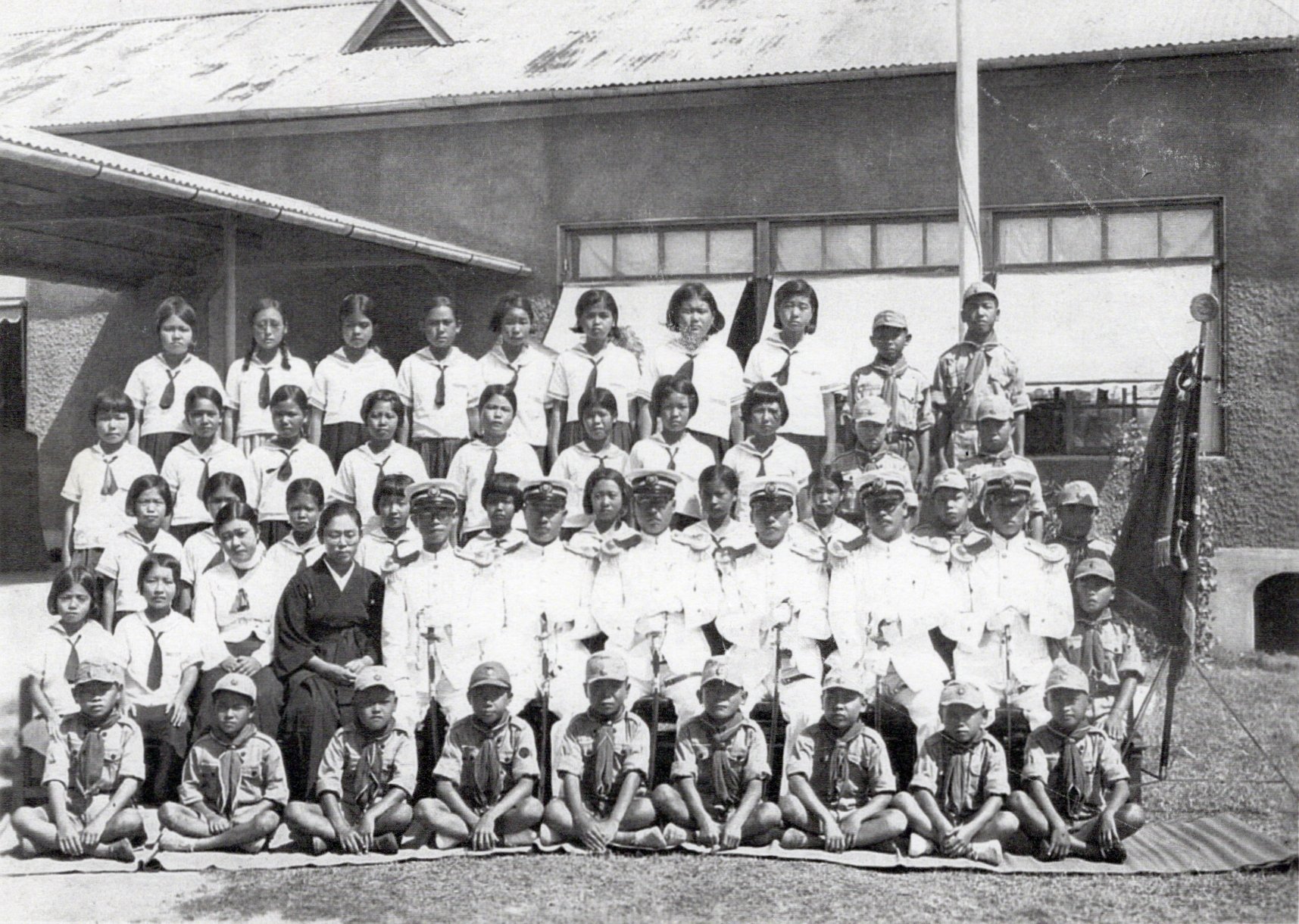
Saipan School students and Boy Scouts posing for a group photo with Nanyo Gunto government officials.

A Carolinian woman threads the neck hair of a younger Carolinian woman.

Group photo of the IJN Yokosuka 1st Communications Unit stationed on Saipan. They are wearing their Class 2 warm weather uniforms, along with their sunhats. Commonly referred to as pith helmets, though this is misleading. With most if not all of the Petty Officers and Sailors wearing communication training badges on the arms opposite of their ranks.

IJN Sailors posing with family. The sailors wear Class 2 warm weather uniforms. The left most sailor bears a single good conduct chevron, and the rank of a 1st Class Seaman. His opposite arm bears the badge of communications training. The sailor in the middle bears no good conduct chevrons, but bears the rank of a 2nd Class Seaman. The Petty Officer stands on the right, his rank out of view, but his communications training badge can be seen on his opposite arm.

IJN Sailors pose for a group photo on the SS Saipan Maru. The SS Saipan Maru was sunk on July 21, 1943.They wear Class 2 warm weather uniforms, with their service caps.

IJN Yokosuka Communications Sailor taking a photo with a local. The Sailor wears his Class 2 warm weather uniform, the wearer’s right arm bears a single good conduct chevron and the 1st Class Seaman rank.

IJN Yokosuka Communications Sailor with a coconut. The Sailor wears his Class 2 warm weather uniform, the wearer’s right arm bears a single good conduct chevron and the 1st Class Seaman rank. HIs opposite arm bears the communication training badge.

Sailors from the Yokosuka Communications unit pose with Carolinian Dancers.

Officers from the Yokosuka Communications unit and Japanese families pose with Carolinian Dancers.

Sailors from the Yokosuka Communications unit pose with Carolinian Dancers.

Carolinians Dancers performing for the Japanese Navy Yokosuka Communications unit and civilians.

Carolinians Dancers performing for the Japanese Navy Yokosuka Communications unit and civilians.

Carolinians Dancers performing for the Japanese Navy Yokosuka Communications unit and civilians.


Base of Mt. Topachau, taken from Chalan Kanoa.
Unknown house

Southern view of Garapan Docks.

Unknown field.

Nanyo-Gunto Government building.

IJN Sailors and unknown woman takes a photo behind vegetation. The Sailors are wearing their Class 2 warm weather uniforms with their service caps.

IJN Sailors and unknown woman takes a photo behind vegetation. The Sailors are wearing their Class 2 warm weather uniforms with their service caps.

IJN Sailor and woman pose behind vegetation. The Sailors are wearing their Class 2 warm weather uniforms with their service caps.

IJN Sailors posing in front of shrine. The Sailors are wearing their Class 2 warm weather uniforms with their service caps. The Sailor on the left bears the rank of a 2nd Class Seaman and a communications training badge. The Sailor on the right bears the rank of a 1st Class Seaman with a good conduct chevron, with his opposite arm bearing the communications training badge.

IJN Sailor poses behind a bush. For some reason. The Sailor is wearing their Class 2 warm weather uniforms with their service cap.

Banana

Papaya

IJN Sailor taking a photo with a woman at the Sugar Cane Park Memorial. A Sailor with a good conduct chevron can be seen on the right. The Sailors are wearing their Class 2 warm weather uniforms with their service caps.

IJN Sailor taking a photo with a woman at the Sugar Cane Park Memorial. The Sailors are wearing their Class 2 warm weather uniforms with their service caps.

IJN Sailors at Sugar Cane Park Memorial. The Sailors are wearing their Class 2 warm weather uniforms with their service caps. Their ranks and their communication training badges can slightly be seen.

IJN Sailors at Sugar Cane Park Memorial. The Sailors are wearing their Class 2 warm weather uniforms with their service caps. Their ranks and their communication training badges can slightly be seen.
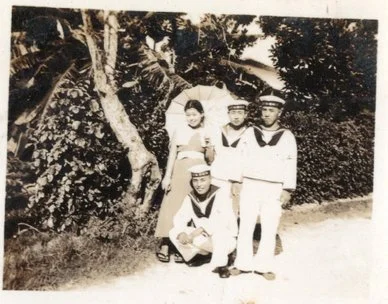
IJN Sailors and women posing. The Sailors are wearing their Class 2 warm weather uniforms with their service caps. Their ranks and their communication training badges can slightly be seen.

IJN Sailors and women posing. The Sailors are wearing their Class 2 warm weather uniforms with their service caps. Their ranks and their communication training badges can slightly be seen.

IJN Yokosuka Communication Sailors taking a group photo with locals wearing traditional Carolinian clothing. The Sailors are wearing early anti-heat uniforms and sunhats.

Daily life for locals.

Carolinian locals pose for a photo.

Carolinian woman poses for a photo.

Papuan man poses for a photo.

Carolinian man poses for a photo.

Chamorro man leans against the Japanese Hospital during it’s construction. The Hospital still stands today and is currently a museum dedicated to the history of the CNMI.